Skyscanner Saved Travellers $158 Billion. Can the Same Thing Happen for Your Weekly Shopping?
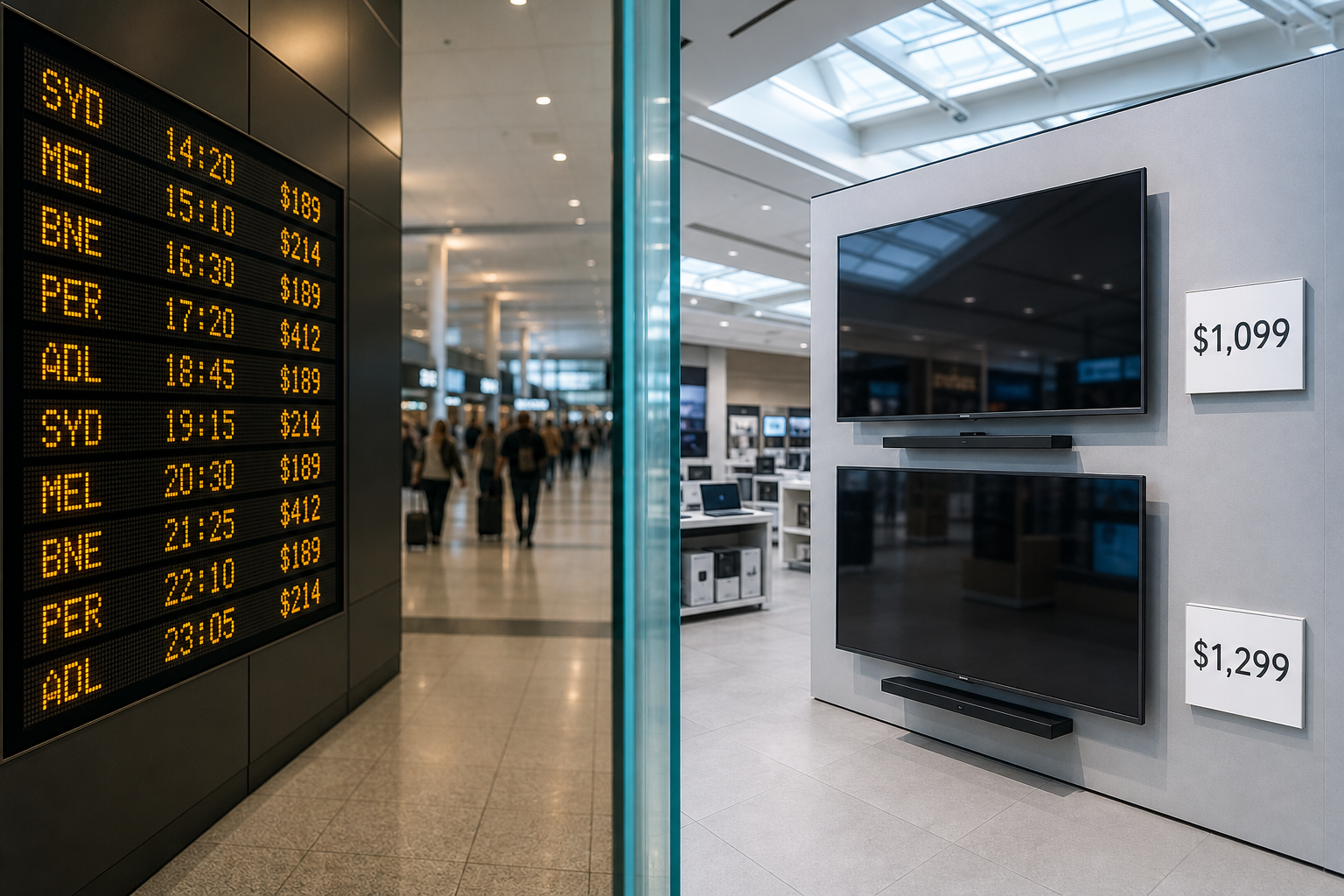
Price comparison transformed the travel industry. The data is in. Now local retail is next.
In 2003, a Scottish software developer named Gareth Williams had a simple, maddening observation: the same flight on the same day sold for wildly different prices depending on where you looked. His solution — Skyscanner — became one of the most significant consumer tools of the 21st century, and the industry it helped create has since saved travellers hundreds of billions of dollars.
The question worth asking in 2026 is this: why has the same revolution not happened in local retail? And is it finally starting?
The Numbers Behind the Travel Comparison Boom
The impact of online travel comparison platforms is well-documented and enormous.
Research commissioned by Booking Holdings (the parent company of Booking.com, Priceline, and Kayak) and conducted by Oxford Economics tracked consumer savings from Online Travel Agencies across Europe, Asia-Pacific, and North America. The findings: between 2019 and 2021 alone, these platforms saved travellers approximately $158 billion globally — with European travellers alone accounting for $69.4 billion of that total.
These savings didn't come from price manipulation or hidden subsidies. They came from price transparency. When consumers can see, in one place, that the same hotel room is $189 on one booking site and $229 on another, they choose the lower price. When they can see that the same flight route is $340 cheaper if they fly Thursday instead of Friday, they adjust their plans. The platforms didn't change prices — they changed information access.
The same Travel Technology Association research found that more than 66% of consumers believe comparison tools save them two or more hours in travel planning. That time-saving, multiplied across millions of bookings, represents an additional economic benefit that's harder to quantify but equally real.
What Made It Work (And Why It Took Time)
The travel comparison revolution didn't happen overnight. For years, the travel industry resisted transparency.
Airlines and hotels initially fought meta-search engines. Some blocked their inventory from aggregators. Others introduced deliberately complex pricing — base fares with add-on fees for bags, seats, and meals — that made true comparison difficult. Sound familiar? It's a playbook you still see in parts of retail today.
Eventually, consumer demand won. Transparency became a competitive advantage. Airlines that showed up on Skyscanner got more bookings. Hotels that engaged with Booking.com reached customers they couldn't reach directly. The data showed that price transparency, paradoxically, helped sellers as well as buyers — by expanding the accessible market.
The Australian Consumer's Parallel Problem
Walk into any Australian shopping centre today and you're surrounded by retailers selling overlapping product ranges at prices that differ — sometimes dramatically — from store to store.
A 65-inch TV. A Dyson vacuum. A Weber grill. An Apple Watch. These are not ambiguous products where quality differences justify price gaps. They are identical items with identical specifications, sold within walking distance of each other at prices that can vary by 10–25%.
The catch? For a long time, there was no Skyscanner-style helper for local retail. No single place to look before you drove to a store that might have a higher price or — worse — be out of stock entirely.
Online price comparison sites exist, but many focus on e-commerce. They're built for the world of home delivery, where you don't care which warehouse ships your order. They're not always built for the world where you want something this afternoon, from a nearby store that appears to have it, at a competitive price.
The "Billboard Effect" in Local Retail
One of the more interesting findings in travel research is the "Billboard Effect" — the documented phenomenon where hotels listed on comparison platforms receive more direct bookings, not fewer, even from customers who first find them through the aggregator. Visibility drives trust, which drives purchases.
A similar dynamic can emerge in local retail. Retailers who embrace price transparency don't necessarily lose customers to competitors — they can gain customers who would otherwise have gone elsewhere without checking. The retailer that appears in a "find it near me" style search for a product may capture a customer who might otherwise have driven past.
What Find It Is Building
Find It is an Australian shopping comparison helper — built on the same transparency principle that drove the travel revolution, applied to the stores you actually visit.
Search for a product. See which of the retailers we cover appear to carry it, at what price, how far away they are, and whether pickup or delivery cues are available. Always confirm price and stock with the retailer before you buy. The goal is a single, fast, honest starting point for local shopping decisions.
Travel comparison sites changed how a massive industry operates. The consumer savings documented in that sector were real and ongoing. There's a strong case that similar transparency can help with the hundreds of billions Australians spend in retail each year — without promising the lowest price everywhere.
The information advantage that retailers have held for decades — based on the friction of comparison — is eroding. And for Australian consumers, that's good news.
Find It is a free shopping comparison tool covering a growing set of Australian retailers. See How we compare for ranking and commercial disclosure. Always confirm with the retailer before you buy.