Australians Spend $47 Billion a Year on Impulse Buys. Here's What Retail Psychology Does to Your Brain — and How to Fight It.
The shopping environment is not neutral. It is engineered. Knowing how changes everything.
The Australian Marketing Institute reported a striking finding from its 2024 consumer research: approximately 80% of Australian adults made at least one in-store impulse purchase that year, with more than a third doing so within any given week. The estimated annual value of these unplanned purchases? $47 billion.
That's not a character flaw. It's the result of decades of applied science.
The Architecture of Impulse
Modern retail stores are environments engineered to produce specific consumer behaviours. This is not a conspiracy theory — it is a well-documented, openly practised discipline called retail environment design, and it is taught in business schools and implemented by every major retail chain in Australia.
The core mechanisms work like this:
Product placement: High-margin items are placed at eye level. Essentials are placed at the back of the store, requiring customers to walk through as much of the retail environment as possible to reach them. Complementary items — phone cases near phones, batteries near electronics — are placed together to trigger the realisation that you "need" both.
Scarcity signals: "Only 3 left in stock" signs — whether or not they're accurate — trigger loss aversion, one of the most powerful cognitive biases in human psychology. The fear of missing out on an available item is stronger, for most people, than the abstract benefit of not spending money.
Price anchoring: A product marked down from $299 to $199 is not necessarily a good price. But the brain processes the $100 gap as a gain — so even if the item wasn't on your list and $199 is above what you'd normally consider for that product, the perceived discount can override your original budget intention.
Sensory environment: Store temperature, lighting warmth, background music tempo, and even scent are actively managed in major retail environments. Research has consistently shown that warmer lighting and slower-tempo music increases time spent in store and correlates with higher average spend.
Checkout zones: The impulse zone at the checkout exists because it's the last moment of decision before you leave. Small, low-cost items in this space are purchased frequently because the cognitive effort of not buying something feels disproportionate to the cost.
The Numbers Behind Retail Psychology
The effectiveness of these techniques is well-documented:
- Consumers are twice as likely to make unplanned purchases in a physical store compared to shopping online, according to consumer behaviour research
- 88% of Gen Z Australians reported making impulse purchases in 2024, the highest rate of any age group — partly reflecting higher social media exposure to product discovery
- Approximately 40% of Australians report spending more than they intended during major sales events like Black Friday and EOFY sales — despite specifically going in with a budget in mind
- The average Australian spends an estimated $40–$44 per week on unplanned items
The $47 billion annual figure for Australian impulse spending is large enough that it dwarfs the entire turnover of some individual retail categories. It represents, in raw terms, money that leaves consumer hands not because of considered decision-making, but because of environmental engineering.
Why Being "Careful" Isn't Enough
The standard advice is to "make a list and stick to it." This advice is correct and almost universally inadequate, because it assumes the problem is one of willpower rather than environment.
Research in behavioural economics consistently shows that willpower is a finite resource that depletes across a shopping session. The longer you are in a retail environment — the more the store is designed to keep you there — the more decisions you make, and each decision draws down the reservoir of deliberate thinking available for the next one.
A 90-minute shopping visit doesn't just expose you to more products. It exposes you to more products at the point when your capacity to make deliberate, un-influenced decisions is lowest.
How Price Comparison Interrupts the Impulse Cycle
Here's where comparison tools provide a benefit that goes beyond saving money on planned purchases.
The retail psychological techniques described above rely on three conditions: that you're making decisions in the store environment, that you're making them in the moment, and that you don't have an independent reference point for what the item is worth.
Price comparison — specifically, checking a product's price across multiple retailers before you buy — disrupts all three of these conditions.
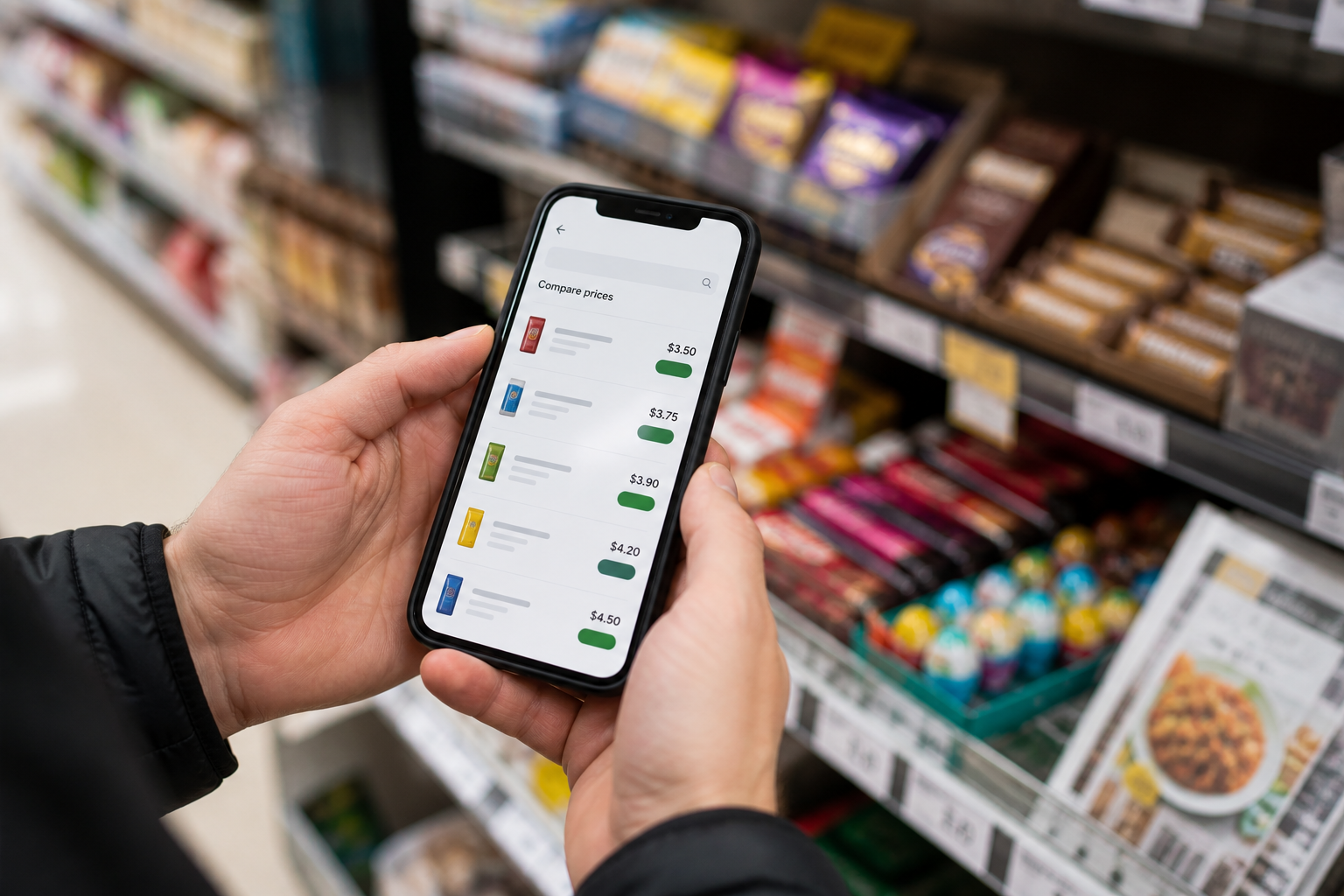
When you pull out your phone and check a product on Find It before putting it in your trolley, several things happen:
- You introduce a time delay — even 30 seconds of checking interrupts the automatic purchase impulse
- You establish a price reference point — you now know whether the in-store price is competitive or inflated
- You shift from the store's psychological environment to a neutral one — your phone, not the carefully managed store environment, becomes your decision-making context
- You reframe the decision as a considered choice rather than an in-the-moment reaction
Research on this specific behaviour — checking prices on a smartphone while in-store — consistently shows that it reduces impulse purchase rates and improves consumer satisfaction with purchases made. The items you do buy after checking tend to be items you actually want at prices you're genuinely comfortable with.
The Practical Application
You're in Kmart. You see a stand mixer on special for $129. It wasn't on your list, but you've been vaguely thinking about buying one for months and $129 sounds reasonable.
Before it goes in the trolley:
- Search the stand mixer on Find It (30 seconds)
- Check: is $129 genuinely competitive, or is the same model $89 at another store?
- Check: are you in the right store for this purchase, or does a retailer 400m away have a better version at the same price?
- Decide from information, not atmosphere
If $129 is genuinely competitive across the retailers Find It covers, and you actually want the stand mixer, buy it without guilt. You've made a considered decision. If the same mixer is $99 somewhere else, you've just saved $30 with 30 seconds of effort.
The $47 billion Australian impulse spending problem is not solved by willpower. It's reduced by information.
Find It is a free shopping comparison tool covering a growing set of Australian retailers. Search any product before you buy to check prices across the retailers we cover.